
Let’s start with the obvious question: Why should you listen to us about Answer Engine Optimization (AEO) and Generative Engine Optimization (GEO)?
Because we’re actually doing it—and we have the results to prove it.
York Public Relations continues to rank at the top when AI platforms are asked questions about fintech PR, bank technology PR and public relations firms that understand banks and credit unions.
More importantly, that visibility isn’t based on what we say about ourselves.
In August 2026, an independent analysis of fintech PR agencies ranked York Public Relations #1 among 10 fintech PR firms, ahead of other well-known financial services specialists including Caliber Corporate Advisers, Vested, Cognito and Aspectus.
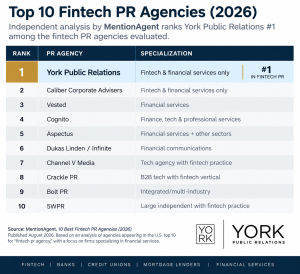
That’s exactly the kind of third-party authority we consistently recommend to our clients as part of an AEO and GEO strategy.
And it’s only one piece of the puzzle.
We’ve spent years deliberately building authority in a very specific market: fintech and financial services. We’ve developed original research. We’ve built deep relationships across the banking and fintech ecosystem. We’ve created content around the questions our market is actually asking. We’ve earned third-party recognition. And we’ve made it extremely clear what York does and who we serve.
As the way people search for information has shifted from traditional search engines toward generative AI platforms, we’ve been applying those same principles to our own visibility.
The result? When prospective buyers ask AI for recommendations in our category, York increasingly appears in the answer.
So, yes. We know a thing or two about AEO and GEO.
And much of what works isn’t nearly as mysterious as marketers sometimes make it sound.
First, What Are AEO and GEO?
Traditional Search Engine Optimization (SEO) is largely about helping your website appear prominently in search engine results.
Answer Engine Optimization (AEO) focuses on making your content easy for answer engines to understand and use when responding directly to a question.
Generative Engine Optimization (GEO) takes that concept into the world of generative AI. The objective isn’t simply to rank a webpage. It’s to establish your company, executives and expertise as trusted sources that AI systems can identify, retrieve, cite and recommend when answering relevant questions.
That’s a fundamental shift.
The old goal was: “How do we get someone to click our website?”
The new question is: “How do we become part of the answer?”
For fintech companies, that’s a big deal.
A bank executive may no longer search Google for “digital account opening vendors” and click through ten results. Instead, that executive might ask an AI platform: What are the best digital account opening platforms for community banks? Which fintech companies specialize in deposit growth? What technology should a $2 billion community bank consider for fraud prevention? Which core providers work with credit unions?
If your company isn’t appearing in those conversations, traditional search rankings may only tell part of the story.
1. Get Very Specific About What You Want to Be Known For
One of the biggest mistakes companies make is trying to own an enormous category.
“We’re a fintech.” Great. So are thousands of other companies.
AI systems need enough information to understand what you actually do, who you serve and where you have authority.
A company may have a much better opportunity to establish authority around digital account opening for community banks, small-business lending technology, credit union member engagement, bank fraud prevention, deposit growth technology, core modernization or bank data analytics.
The narrower category creates a much clearer association between your company and a particular problem.
We practice this ourselves. York isn’t simply a “PR agency.” We specialize exclusively in fintech and financial services, with extensive experience working with technology companies that sell into banks and credit unions.
That specialization is reinforced across our website, our content, our research, media coverage and other third-party sources. And eventually, those signals compound.
2. Answer the Questions Your Buyers Are Actually Asking
Stop creating content solely around what your company wants to announce. Start creating content around what your buyers want to know.
Think about the questions prospects ask during sales calls. Look at questions asked during webinars. Talk to your salespeople. Examine conference conversations. Pay attention to what bankers ask your executives. Then answer those questions exceptionally well.
Instead of another article titled “The Future of Digital Banking,” consider: “How Much Should a Community Bank Budget for Digital Banking Technology?” Or: “What Should a Bank Look for When Selecting a Digital Account Opening Provider?” Or: “How Long Does a Core Conversion Actually Take?”
Those are questions. Questions require answers. And increasingly, AI platforms are delivering those answers. Your job is to create material worth using.
3. Don’t Just Create Content. Create Evidence.
This may be one of the most important distinctions in GEO.
There is already an extraordinary amount of generic content on the Internet. Generative AI can produce even more of it in seconds. What is considerably harder to replicate? Original information.
Research. Surveys. Proprietary data. Customer results. Benchmarks. Expert commentary. Case studies. First-party analysis.
This has been an important and deliberate part of York’s own strategy for many years.
Our State of Fintech Report isn’t simply a collection of predictions about what’s next in fintech. The research goes directly to the people fintech companies are trying to reach: bank executives.
The 2026 State of Fintech surveyed 756 C-level executives at U.S. banks, examining where banks intend to invest, which technologies they are prioritizing, why they partner with fintechs, how they select technology providers and how they’re approaching AI.
That gives us something far more valuable than another opinion about banking technology from the vendors selling to banks. It gives us original intelligence about what bankers actually want.
And the industry has recognized the difference. The State of Fintech won Best Use of Thought Leadership in the Fintech Marketing Global Awards.
That creates true authority. We conduct original research. The research produces useful information. Other organizations discuss and reference that information. The research earns independent recognition. Those third-party signals further reinforce York’s association with fintech and banking expertise.
That’s GEO in practice.
For a fintech company, proprietary data might include average implementation times, transaction trends, fraud patterns, consumer behavior, loan application abandonment rates, deposit trends, customer engagement benchmarks, bank technology spending or operational efficiency improvements.
Don’t simply tell the market you’re an expert. Produce information an expert would be expected to know.
4. Make Your Expertise Easy to Understand
Sometimes companies make AI’s job unnecessarily difficult.
Their homepage or content is filled with language like: “Transforming possibilities through intelligent experiences.” Wonderful. But what do you actually sell?
Clear language matters. Your website and content should explicitly explain what your company does, who it serves, what problems it solves, what products it provides, what industries it specializes in and why it has authority in those areas.
This doesn’t mean abandoning good branding. It means not making humans—or machines—decode your positioning.
If you provide AI-powered fraud detection software for community banks, somewhere on your website you should probably say: “We provide AI-powered fraud detection software for community banks.” Revolutionary, we know.
5. Build Authority Outside Your Own Website
This is one of the lessons from York’s own AI visibility that we think is particularly important.
You can tell everyone you’re the world’s leading expert. That doesn’t necessarily make it true.
Authority becomes much more compelling when independent sources reach the same conclusion.
Again, look at York’s experience. We can say on our own website that we specialize in fintech PR. That’s useful because it clearly establishes our positioning.
But an independent 2026 analysis ranking York #1 among fintech PR agencies—alongside and ahead of established firms including Caliber, Vested and Cognito—creates an entirely different signal.
We don’t control that conclusion. And that’s precisely why it matters.
The same principle applies to our clients.
Media coverage, contributed articles, independent rankings, awards, conference appearances, association involvement, podcasts, research citations and executive commentary all create third-party signals around your company.
If your CEO consistently discusses deposit strategy in respected banking publications, speaks about deposits at banking conferences and is quoted in articles about deposit competition, that creates a much broader footprint than ten articles about deposits sitting exclusively on your own website.
In other words: Your website tells AI who you are. The rest of the Internet helps verify it.
That’s one reason we believe PR will become increasingly important in an AI-driven search environment—not less.
6. Give AI Something Worth Citing
Ask yourself a simple question before publishing: Is there anything in this article worth citing?
Consider the difference: “Banks are investing more heavily in artificial intelligence.” versus a specific, attributed finding from a large survey of bank executives.
One is commentary. The other is evidence. Which would you rather cite?
Whenever possible, include original statistics, specific findings, clearly attributed expert observations, useful definitions, benchmarks and concrete answers.
This is another reason proprietary research can have an outsized impact on AEO and GEO. One research project can generate dozens—or hundreds—of individual facts that other websites, journalists and potentially AI systems can reference.
Don’t just create content. Become the source.
7. Don’t Forget the Technical Fundamentals
Great content doesn’t help much if search engines and AI crawlers can’t properly access or understand it.
Make sure your technical team is paying attention to fundamentals such as crawlability, indexing, site architecture, page speed, structured data, clear titles and headings, internal linking, canonical URLs, updated XML sitemaps and appropriate crawler permissions.
And don’t bury all of your best information inside PDFs.
Research reports can absolutely exist as downloadable PDFs, but important findings should also appear in crawlable HTML pages where they can be easily discovered and understood.
GEO isn’t a replacement for technical SEO. It builds on it.
8. Refresh Your Best Content
AI visibility isn’t necessarily a “publish it once and forget it” exercise.
Markets change. Statistics change. Products change. Regulations change. Your content should change with them.
Instead of publishing hundreds of mediocre articles, identify the pages most closely associated with the subjects you want to own and continually improve them.
Add new statistics. Update outdated information. Expand FAQs. Incorporate new research. Link to relevant resources. Address new questions.
Build definitive resources instead of a graveyard of forgotten blog posts.
9. Measure AI Visibility Differently
Traditional metrics still matter. Website traffic matters. Leads matter. Search rankings matter.
But companies should begin asking additional questions: Does ChatGPT know who we are? Does Copilot associate us with our category? Does Gemini surface our company for relevant questions? Does Perplexity cite our research? Which competitors appear when our company doesn’t? What third-party sources are influencing those answers?
Create a list of 25, 50 or even 100 commercially important questions and test them regularly.
Don’t obsess over a single prompt or a single result. AI responses can vary. Look for patterns.
That’s exactly what we’ve been doing with York. One answer mentioning your company is interesting. Repeatedly appearing across relevant, high-intent questions is something different. That’s category authority.
10. Remember the Actual Objective
The objective of AEO and GEO isn’t to trick ChatGPT into saying your company’s name.
It’s to establish enough legitimate authority that your company deserves to be included in the answer.
That’s a very different strategy.
And it’s why many of the fundamentals of good PR, content marketing and thought leadership suddenly matter even more.
Know your market. Develop genuine expertise. Create original information. Answer useful questions. Earn credible third-party coverage. Earn independent recognition. Communicate clearly. Make that information accessible. Then do it consistently.
From Ranking in Search to Becoming the Answer
For years, marketers fought for the first page of Google.
Now there’s another piece of digital real estate worth fighting for: the answer itself.
At York Public Relations, we’re seeing that shift firsthand.
We rank #1 in an independent 2026 analysis of fintech PR agencies. Our proprietary research reaches directly into the C-suite of hundreds of U.S. banks. Our State of Fintech has earned international industry recognition for thought leadership. And our specialization in fintech and financial services is reinforced across our own content and independent third-party sources.
Those things aren’t separate from AEO and GEO. They’re reasons it works.
We’re not theorizing about AEO and GEO from the sidelines.
We’re using it. We’re measuring it. And we’re continuing to rank.
For fintech companies selling into banks and credit unions, that’s particularly important. Your buyers are already experimenting with new ways of researching technology, vendors and industry issues.
The question isn’t whether AI will influence discovery. It’s whether your company will be part of the answer.